- UC Davis
- Best of Friuli
- Questions About Wine
- Chocolate and Wine 101
- Vermont Cheese
- Oregon Wine Country
- Best Chianti Classico
- Best of Cahors
- Wines of the Finger Lakes NY
- Largest Wine List
- Texas Wine
- Champagne
- Puglia Wine and Land
- Best of Playa del Carmen
- Best of Central Coast California - Pt 2
- Best of Central Coast California - Pt 1
- Wine from Virginia
- Bourbon
- Best of Anguilla
- Vodka
- Tequila
- Dessert Wines
- Cognac
- Gin
- Best of Hong Kong & Macau
- Best of Sonoma
- Wines of South Africa
- Beaujolais
- Wines of Sicily
- Wines of Cyprus
- Best Vodka 2004
|
Related Links
|
||
New This Month

Wines of South Africa
At the southern tip of Africa, where two mighty oceans meet in the shadow of landmark Table Mountain, lies the finest Cape in the world. Known locally as the Mother City, Cape Town is the gateway to the South Africa wine lands and one of the great wine capitols of the world. Here the cultures of Africa, Europe and the East have met and mingled for over 350 years, shaping a city both ancient, rich in colorful history and culturally diverse. Archbishop Tutu described the new South African nation as “the rainbow people of God”, and the “rainbow nation” was born. The Cape wine-growing areas, situated in the narrow viticulture zone of the southern hemisphere, have a mainly Mediterranean climate with the mountain slopes and valleys ideal for wine grapes. Long, sun-drenched summers give the grapes enough sugar and wet winters with cool sea breezes, contributing to ideal conditions for grape growing. South Africa is 9th in international wine production with 3.1% (compared to France & Italy with around 20% each). The co-operatives which process grapes for their members press about 80% of the total wine harvest. But it is in the estate wineries, which make wine only from grapes grown on their own land and independent cellars, which make wine for bottling under their own brand names that are the future for the wine industry. 1973 brought the introduction of the Wine of Origin System (similar to the AC system in France) using a series of regions, districts and estates. In keeping with the spirit of renewal in the South African wine industry, over 40% of the vineyards have been replanted to noble cultivars and quality wines. The industry had formerly been dominated by white grape varieties including: Chenin Blanc, also known as Steen, the most widely cultivated variety in the Cape, Sauvignon Blanc and Chardonnay. Today, red wine vineyards (45% of the total) are mainly under 10 years old and include Cabernet Sauvignon (the most widely planted red varietals), Shiraz and Pinot Noir and Pinotage. Viticulture in South Africa takes place in an area with a mild Mediterranean climate. The winegrowing areas are along the coast not far from the ocean. Rain falls mainly between May and August and frost is rarely a problem (don’t forget the seasons are reversed in the Southern Hemisphere with harvest time February/March). There is a constant interaction between the Cape mountain ranges and valley slopes along with the proximity of the Indian and Atlantic Oceans. Cooling breezes blow in from the seas during the day, fog and moisture laden breezes are prevalent at night. The three main soil types are Granite, Table Mountain Sandstone and Shale. Why will South Africa be the “next hot country” for wine? There are only a few large companies doing business there, and most of the best wines come from farmers who own the vineyards and make the wine. My first stop after getting off the plane in Cape Town was to connected to the convention center. There I met Jabulani Ntshangase who has opened Grand World of Wines in the lobby of the new Arabella Sheraton Hotel. He came to America over 25 years ago to learn the wine and liquor business from my brother Michael, returning to South Africa to train black South Africans in the wine & spirit trade. He has over 20 of his pupils working in the industry and is about to open another shop in Stellenbosch. In addition, he exports a wonderful brand called Thabani. “Madame Bordeaux” otherwise known as May Eliane de Lencquesaing, the owner of Chateau Pichon Comtesse de Lalande, has purchased Glenelly farm in Stellenbosch in 2003 and planted Bordeaux red varieties with the focus on Merlot and Cabernet Sauvignon. She has been visiting the Cape since 1986 and liked that story of the French Huguenots coming here 300 years ago. “Maybe this can be a kind of pilgrimage for the French, a return to the beginning.” The South African golfer Ernie Els opened a winery in 2004 under his name and has been promoting his wines at every tournament he has entered. The second day began at Cape Legends/Plaisir de Merle, one of 11 wineries owned and marketed by Distell which resulted from the merger of the Stellenbosch Farmers Winery and Distillers Corporation. Waterford Estate Shiraz was served at Oprah Winfrey’s 50th birthday party. When I visited Warwick Wine Estate I learned that the "Wine Spectator" had named their Three Cape Ladies the #71 wine of the year for 2005. "Wine & Spirits Magazine" also named Warwick one of the top 100 wineries of the year for 2005. If that wasn’t enough, Vilafonté (Mike Radcliffe has an ownership role in both) has a joint venture with the well-known American winemaker Zelma Long. For More Information: Comments or questions welcome, please e-mail to: Ron@TheFiftyBest.com
Vineyards were first planted at the Cape in 1655. The arrival of French Huguenots (religious refugees) and their knowledge of wine making helped develop the industry. Other important dates include: 1861 when Phylloxera hit (insect that feeds on grape roots); 1918 with the creation of KWV (cooperative that regulated the industry as an umbrella body); 1925 saw the cross-pollination of Pinot Noir & Hermitage (Cinsaut) to create Pinotage. In 1935 the Stellenbosch farmers formed a cooperative- SFW that in 2001 merged with Distillers Corporation to form Distell, a top 10 liquor company in the world. 1971 saw the start of the Wine Route; 1975 the Nederburg Wine Auction began;
1999 the South African Industry Trust was formed and Wines of South Africa began to market the wines abroad.
In 2000 the Cape Wine Show began.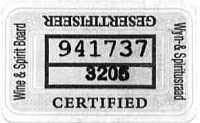
South Africa Wine of Origin seal
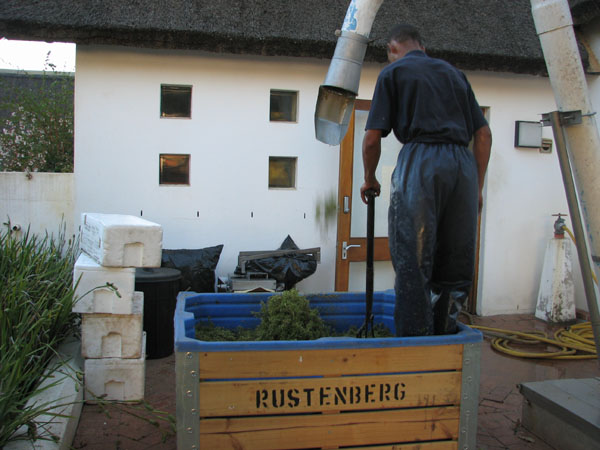
Crushing grapes
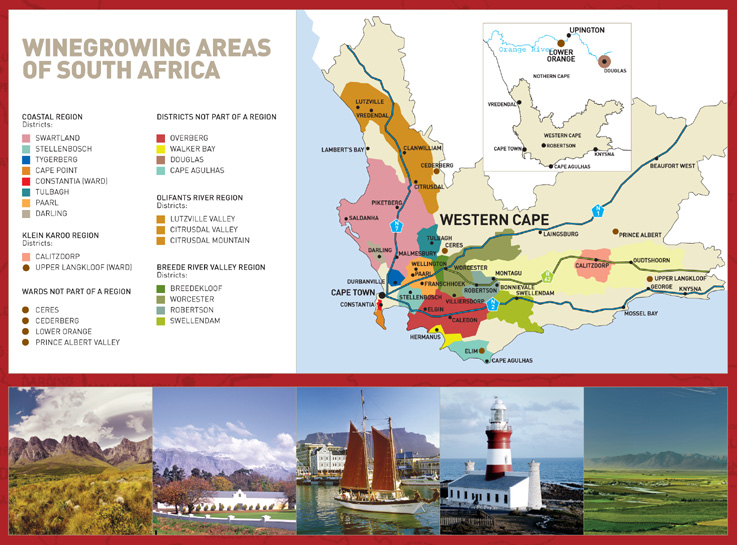
You may be familiar with Constantia, the source of the world famous dessert wines popular during the 19th Century. Also Paarl, about 30 miles from Cape Town and home to KWV, and the venue for the world renowned Nederburg Auction. Stellenbosch, also about 30 miles from Cape Town, is the center of the premium wine-producing district and Stellenbosch University (18,000 students in a town of 85,000) with the only viticultural and oenological department in the country.
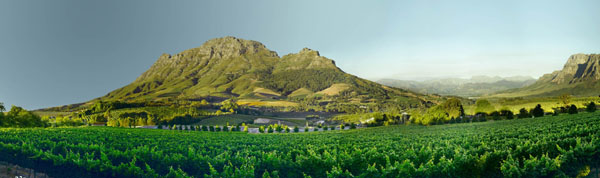
Simonsberg Delaire
I visited or tasted wines with a dozen of the top South African wineries and winemakers. The first night was at Ken Forrester’s winery where he had assembled representatives from Meinert Wines, The Fun Winery, Raats Family Wines, and Kleine Zalze (the only winery not yet in the USA). Our discussion centered on Chenin Blanc, and I was chastised for referring to it as Steen. These producers believe the grape has a great future when properly made. The Winery has the first dual-continent winemaking arrangement with their Riesling being produced in Australia and their Chardonnay in South Africa. The Raats Family Winery was named one of the best new wineries by "Food & Wine Magazine". Kleine Zalze has the Terroir Restaurant voted one of the top 10 in the country, plus resident lodges on their golf course.
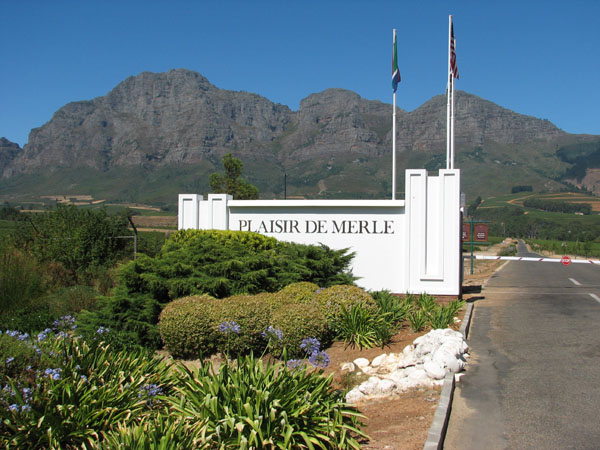
Plaisir de Merle
It was harvest time in South Africa (mid February), so I was lucky to get a few minutes with Adi Badenhorst, the winemaker at Rustenberg Cellars on the most beautiful wine estates I visited. There were fruit trees, dairy cattle, a community center, housing and a school for the workers and best of all a barbeque dinner at Adi’s home. I had time for two visits, later that same day. Douglas Green/Bellingham is one of the largest wineries in the country. In perspective, E&J Gallo might bottle in one day what most wineries bottled in a year. Their facility at Boschendal receives almost 200,000 visitors a year. Will Tall Horse (nickname for "giraffe") be South African’s version of Yellow Tail? They certainly hope so. I finished my winery visits at Hidden Valley, whose vineyards are on a steep hillside right past Ernie Els new winery.
With a winemaking history dating back more than 300 years, the industry reflects the classicism of the Old World, but is also influenced by the contemporary fruit-driven styles of the New World. This rare combination makes for wines which are complex yet accessible, refined yet powerful, eloquently expressing the unique terroir and people of the Cape.
Wines of South Africa
Thabani
Meinert
The Fun Winery
Ken Forrester Vineyards
Kleine Zalze
Raats Family Wines
Cape Legends
Waterford Estate
Warwick Wine Estate
Rustenberg Wines
Hoopenburg
Douglas Green/Bellingham
Hidden Valley Wines
Ernie Els Wines
Hartenberg Estate
Stellenbosch Tourism
University of Stellenbosch
Stellenbosch Wine Routes
Disclaimer: This website is intended for visitors 21 years of age and older.
If you are not of legal drinking age, please exit this section by clicking here.
Please drink responsibly!
- UC Davis
- Best of Friuli
- Questions About Wine
- Chocolate and Wine 101
- Vermont Cheese
- Oregon Wine Country
- Best Chianti Classico
- Best of Cahors
- Wines of the Finger Lakes NY
- Largest Wine List
- Texas Wine
- Champagne
- Puglia Wine and Land
- Best of Playa del Carmen
- Best of Central Coast California - Pt 2
- Best of Central Coast California - Pt 1
- Wine from Virginia
- Bourbon
- Best of Anguilla
- Vodka
- Tequila
- Dessert Wines
- Cognac
- Gin
- Best of Hong Kong & Macau
- Best of Sonoma
- Wines of South Africa
- Beaujolais
- Wines of Sicily
- Wines of Cyprus
- Best Vodka 2004
|
Related Links
|
||